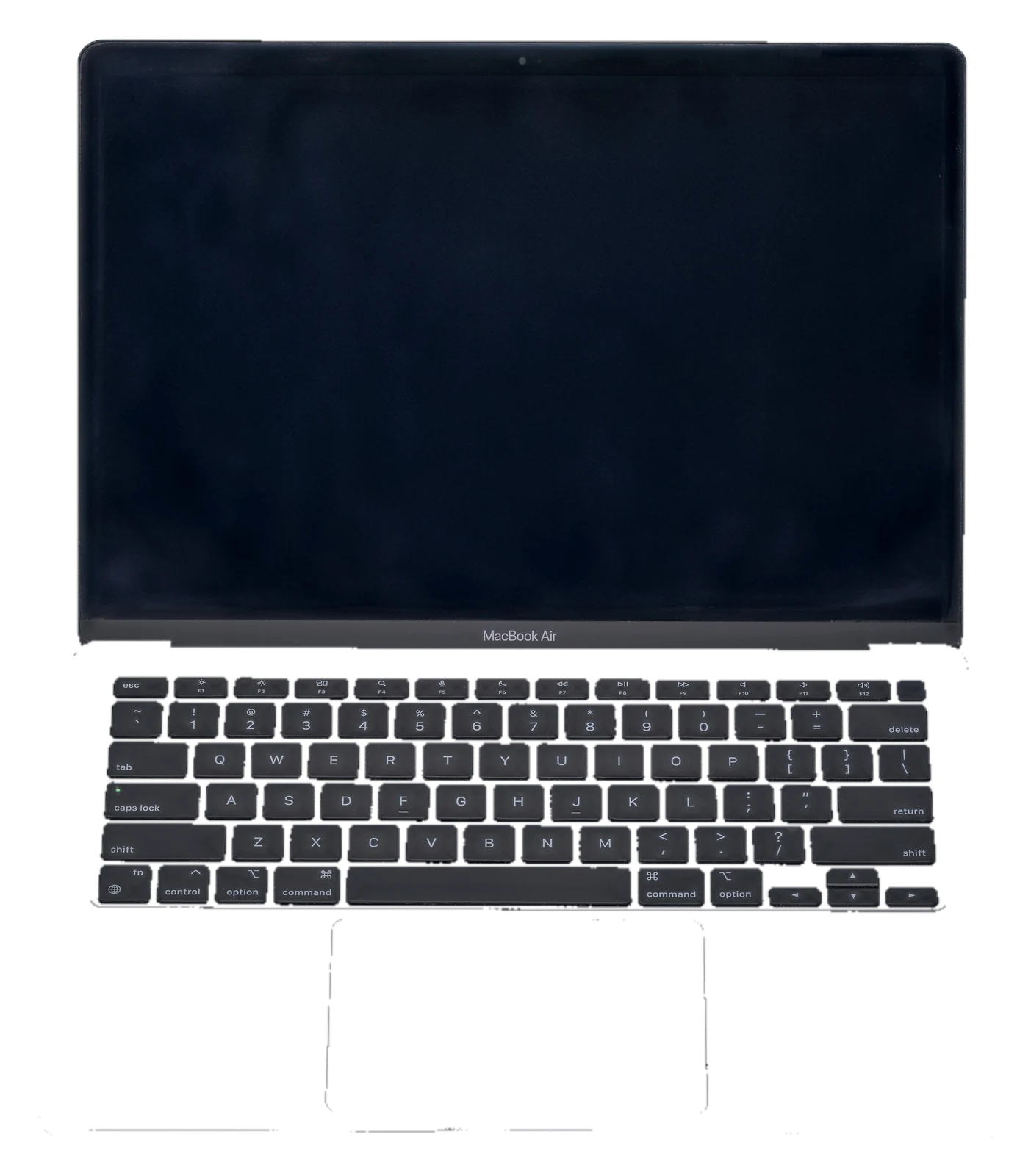

How the Pocket runtime family puts small, always-on, guest-programmable presences on the desktop — and the first runtime built on it: Pocket Stage, which mounts real Pocket apps into authored 3D devices and rooms.
This document names and generalizes what pocket-character proved, and specifies the next runtime that needs the generalization. It follows the RUNTIMES.md ontology: a widget runtime is still ⟨Cores, Surfaces, Guest⟩; pocket-widget is the mechanism layer that makes the desktop-widget form factor a reusable capability instead of a per-app reinvention.
1. The capability
A desktop widget is the smallest unit of ambient software: one always-on-top, transparent, undecorated window that lives on the desktop for hours. The form factor puts two hard constraints on the architecture:
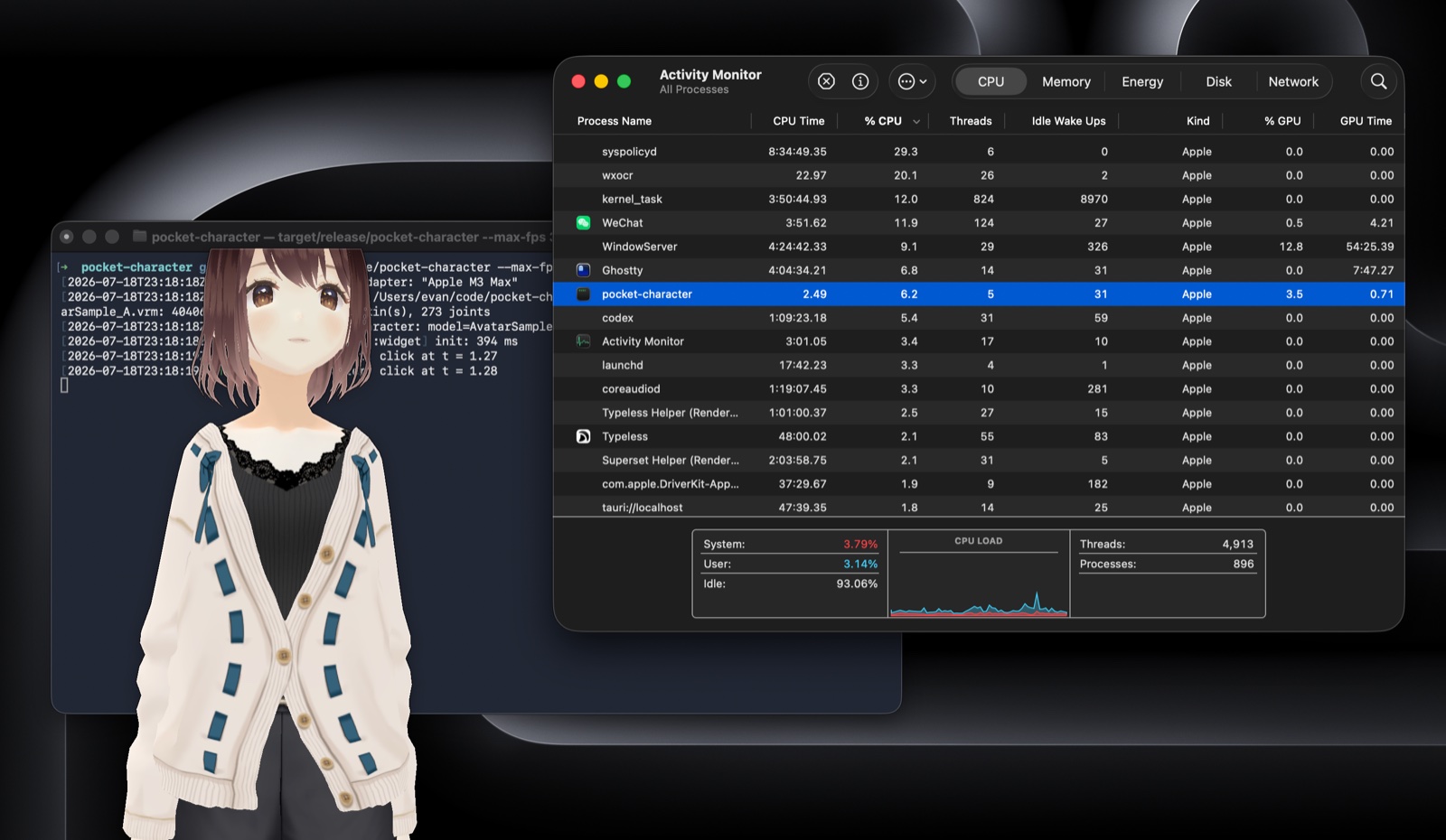
- Idle must cost almost nothing. A widget is judged by what it burns at rest, not at peak. pocket-character measured the gap: the same character stage costs 8 processes / 2184 MB / 44% CPU on Electron and 1 process / 118 MB / 3.9% CPU on the Pocket stack — while rendering 60 fps of skinned, spring-boned 3D continuously. A widget whose content is mostly static should land far below even that.
- Behavior must be a bundle, not a build. Which app the widget hosts, how it reacts, what its personality is — guest program, hot-swappable, sandboxed by construction (capability = surface).
pocket-character satisfied both, but its host is product-specific code. The generic halves it left upstream (AppConfig widget-window mode, transparent clear, max_fps pacing, morph/pose machinery — pocketjs #125) are window plumbing, not the full capability. pocket-widget is the missing middle: a pocket3d-workspace mechanism crate, sitting beside pocket-mod and pocket-ui-wgpu in the RUNTIMES.md table:
| Piece | Role |
|---|---|
shell | The window contract and its event loop: transparent / undecorated / always-on-top (from #125) plus occlusion suspend, per-press drag-to-move / resize-grip policy hooks, optional live resizing, and the governor of §4 — fixed-rate guest ticks, demand-driven GPU frames, with a frames-vs-ticks receipt logged on exit. One governor, two widget shapes: WidgetGame (3D — scene, camera, embedded screens) and FlatWidget (2D — the window IS the ui surface, one render_words_scaled pass, no scene). |
embed | A full PocketJS ui surface rendered off-window: pocket-ui-wgpu draws the core's DrawList into a persistent OffscreenTarget. A semantic glTF material override binds that texture view directly to the authored screen primitive. A screen inside a widget is a real app, not a video or a second overlay window. The per-tick DrawList content hash is the dirty signal. |
parts + pick | The interaction vocabulary: named part shapes (btn_cross, dpad_up, nub, screen) → spec BTN bits, analog packing (raw extremes 255/1, never 0), the shared uihost keyboard map, and cursor-ray picking against oriented part bounds (event-driven, CPU, cold path). Procedural shells can register parts directly; authored shells declare cheap proxies in package data, so visual topology never enters the picking hot path. |
What stays out of pocket-widget: any specific model, part map, or behavior — those are the product. (pocket-character retrofits onto shell naturally; that refactor is desirable but not a blocker.)
2. The first runtime: pocket-stage
Pocket Stage is the model-neutral process contract that combines an authored 3D asset, camera policy, interactions, and one or more live Pocket app surfaces inside a low-power widget window. The checked-in PSP and iPod nano packages prove that EmbeddedUi + PartMap carry real weight:
- Borderless, transparent, always-on-top window framing a 3D PSP.
- The PSP's screen is a live 480×272 PocketJS
uisurface — the same DrawList renderer that drives PSP hardware, not an emulator. PPSSPP renders a machine; we render the app, because the app was never PSP-binary-shaped to begin with. - The PSP's buttons are pickable meshes. Click CROSS and the guest's next
frame(buttons, analog)carriesBTN_CROSS— the identical bit the real hardware's pad register produces. Drag the analog nub and the guest sees the same packed axes a real nub produces. - Therefore: any PocketJS app whose fixed viewport variant passes the Stage surface admission boots unmodified. The outer macOS window has
form: "widget", but the guest is mounted on a screen mesh and therefore resolves againstform: "embedded". A fixed 480×272 PSP/Vita app fits; a dynamic-only desktop app such as Pocket Note is correctly rejected until it declares a compatible fixed variant. - The iPod package selects a different 176×132 surface and tall camera/window framing through the same profile loader. Its click wheel is the first
rotary-wheel@1adapter: circular drag or trackpad scroll over the ring is quantized to ordinary UP/DOWN BTN edges, while tap sectors deliver MENU, previous, next, and play/pause. No iPod-only guest ABI or native process exists. - Its music demo uses the existing svc queue as a companion boundary. The guest owns navigation and displays metadata; the macOS host owns local WAV paths and playback. Paused audio and a settled DrawList produce no periodic GPU work. Launch the complete package with
bun run widget:ipod.
The source remains in the historical engine/pocket3d/examples/handheld directory but the Cargo package, binary, process, and window title are pocket-stage. Asset type is data, not a process fork: an iPod, phone, laptop, TV, or room-with-monitor should change the package and typed manifest extension, not introduce another native runtime. The checked-in host is still transitional: these consumed fields still live in profile.json until the strict package manifest migration in §6.1 lands.
In RUNTIMES.md notation:
pocket-stage (Rust bin, macOS)
  = widget shell        (pocket-widget: window, picking, part input, power)
  + stage package       (glTF LODs, views, interactions, provenance)
  + mounts `ui` slots   (pocket-ui-wgpu → OffscreenTarget → display material)
  + mounts `widget`     (optional, §7: hover/led/framing facts and intents)
  + pocket-mod guest    (one unmodified PocketJS app bundle + pak)
There is no new domain vocabulary to invent for v1: the guest-facing surface is the existing ui surface, byte-for-byte. The runtime's novelty is entirely host-side composition.
2b. The second runtime: pocket-note (the flat form)
The other half of the capability, proven by examples/note-widget + apps/note: a markdown sticky note whose borderless, resizable, always-on-top window is nothing but a ui surface — no scene, no camera, one render_words_scaled pass on dirty frames. It exercises everything the 3D form doesn't:
- The window is the app.
FlatWidget+run_flatshare the governor; a settled note renders zero GPU frames (measured: 481 ticks, 2 frames, ~0.7% CPU / 86 MB RSS idle over a windowed run — one process, debug build). - Live resize is a relayout, not a reboot. The host tracks the window, calls
Ui::set_viewport(runtime-legal since #125's plumbing; clamped to the DrawList i16 range) and tells the app, which re-wraps text against the new width via the framework's newresizeViewport(). Borderless windows keep macOS edge-resize; the shell also tracks an explicit grip-corner drag (resize_at,WidgetConfig::resizable/min_size). - The svc channel is the desktop companion contract. The spec mailbox (ops 30..32) needs no new ops for a host that lives in-process: real keyboard/mouse/wheel/resize go to the guest as JSON lines (
{t:"ch"|"key"|"mouse"|"scroll"|"resize"|"load"}), save/quit intents come back ({t:"save"|"quit"}). The app source retains a svc-less read-only fallback, but the current Note manifest is dynamic-only; it must add a fixed viewport variant before a PSP or embedded host can admit that fallback. The §7widgetsurface stays unbuilt. - The desktop surface is first-class in the platform contracts. Six registered capability ids name it (
input.text,input.pointer,input.ime,host.clipboard,display.viewport.live,text.glyphs.runtime— each a distinct observable guarantee; a real pointer is NOTinput.cursor), and amacos-widgettarget profile (hostAbi 3, density 2,dynamicViewportrange) provides them. Target semantics live in queryable profile FIELDS (platform,form— takeover/window/widget/kiosk/embedded); ids are labels (convention<platform>-<form>, future:macos-app,linux-kiosk), and apps declare viewport intent per policy (fixed/dynamicvariants), not per target. Pocket Note currently declares only a dynamic variant and is therefore intentionally admitted bymacos-widget, not by PSP/Vita or an embedded Stage screen. Its desktop-only APIs sit inenhances; if the app later adds a fixed variant, the same source can degrade to a read-only note on hosts without those features. Native hosts assert identity (__host/__hostAbivs the plan's target), andbun run notebuilds through the manifest — density and features come from the profile, not flags. - Clicks are CIRCLE. The host synthesizes the spec press button while the mouse is down; the app resolves hover → focus (
hitFocusable+focusNode) from svc mouse moves, and the framework's stock onPress pipeline dispatches — including into Portal overlays (the hit-test root now spans the overlay layer, fixing menus for every cursor-mode app). - Text editing without an OSK. The
pocket3dInputgrew a per-frame edit-keystroke stream (chars with layout applied, named keys, repeats) and a wheel accumulator; the guest's editor (measured soft wrap, caret math, click-to-caret, drag selection, a coalescing undo/redo stack driven by ⌘Z/⇧⌘Z) is pure JS overmeasureText, unit-tested in bun. Preview mode gets browser-style drag selection over the rendered rows (select.ts — (row, char) space, boundary rows clipped, code blocks atomic) and clicks are inert, exactly like a real markdown preview — edit mode is entered through the eye/pencil toggle. ⌘C/⌘X/⌘V complete the clipboard both ways (the host pipes copy intents to the system clipboard and reads it back for paste). - IME input without a charset. The shell enables OS composition (
WidgetConfig::ime); preedit/commit ride the Input'sime_eventsstream into svc lines, the guest splices the preedit at the caret with an underline, and reports its caret rect back so candidate windows dock next to the text. Coverage is solved at RUNTIME: the host rasterizes unseen codepoints from a system CJK font (mmapped), appends them to the pak's FONT ATLAS v3 blobs (cmap stays sorted, coverage is gid-linear — appending is cheap) and reloads the slot through the specloadFontAtlasop; the wgpu renderer re-uploads any slot whose glyph count moved. No charset guessing, no megabyte paks — a note types 你好 and two glyphs are baked on the spot. Mouse lines carry the primary-button state so the guest sees press/ drag/release, and the guest tells the host while its menu is up so header clicks reach the menu backdrop instead of starting a window drag.
3. Input: from meshes to BTN bits
The bridge is deliberately dumb — a static table, no gameplay logic:
- Buttons.
btn_cross/circle/square/triangle,dpad_up/down/left/right,btn_start/select,trig_l/rmap 1:1 to the spec BTN bits. Mouse-down on a profile proxy sets the bit until mouse-up; keyboard chords compose into the same word (the OSK needs them). The visual model stays a single scene instance; input does not traverse or mutate its 80k–132k triangles. - Analog nub. Drag within the nub's radius maps to the packed axes (
(x << 8) | y, 0–255, 128 center); release springs back to center. Extremes are raw 255/1 — never 0 — matching the input-tape convention. - Rotary wheel. A package-declared canonical XY annulus uses ray/plane intersection plus
atan2, unwraps the ±π seam, accumulates 12° detents, and inserts a neutral guest tick between UP/DOWN pulses. A tap that never crosses a detent resolves to the nearest named angular sector. Trackpad scroll is consumed by the wheel only while the pointer is over the ring; elsewhere the same gesture continues to orbit the stage. - Keyboard, always. The uihost key map (arrows, Z/Enter = CROSS, …) is mounted unconditionally. Mouse-on-model is the magic; keys are the daily driver. Both funnel into one
buttonsword per tick — Law 3 is untouched. - Picking is event-shaped. A cursor ray against profile-authored oriented boxes runs only on mouse events, never per frame. Mesh triangle count is therefore irrelevant to picking cost. Profiles can be generated or hand tuned once per shell without adding model-specific runtime code.
- Click-through. Clicks on fully transparent pixels should reach the desktop behind. v1 ships without it (the window hugs the model, so dead margin is small); the candidate mechanism — toggle the window's cursor hit-test off when the cursor leaves the model silhouette — hangs on the re-entry question in §9. Dragging anything inert moves the window (the shell's per-press
drag_atpolicy).
4. Power: two rates, one clock
The determinism laws stay intact — and they are what make low power cheap to implement:
- The guest ticks at a fixed 60 Hz, always. One guest turn per host tick (Law 3); tapes, goldens, and replays hold inside the widget. An idle QuickJS tick over a settled app is microseconds — the PSP does it at 333 MHz.
- GPU frames are demand-driven. A frame renders only when something is dirty: the
uicore produced a different DrawList (cheap content hash per tick — DrawLists are small), a pose/morph changed (button press), the camera or window moved, or hover state changed. No dirt → no render pass, no present; the compositor retains the last frame. A PSP showing a settled menu costs zero GPU frames. - Native baked animations (the styles.bin timelines) run in the core, so "app is animating" is a core-side fact, not a guess.
max_fpspacing (sleep, not spin) bounds the active case; macOS occlusion events suspend rendering entirely while ticks continue, so the app stays live behind other windows.- The windowed shell explicitly requests wgpu's
LowPoweradapter. On Apple Silicon that remains Metal on the integrated Apple GPU; headless tooling and full-screen game hosts keep the existingHighPerformancedefault. - Measured receipt (M3 Max, 10 s, release build). The static settings app ran 601 guest ticks but presented only 2 GPU frames (0.3%); the hero app, whose spinner keeps changing, presented 224 (37.3%). Total process CPU time was 0.21 s and 0.40 s respectively over about 10.2 s wall time, nowhere near one saturated core. A longer static run sampled at 0.7–1.0% CPU and about 161 MB RSS after startup.
/usr/bin/timepeak RSS was 218–221 MB because it includes GLB decode/upload; this is not a direct GPU power measurement. These are local samples, not cross-machine guarantees; the exit receipt is the repeatable check.
5. Screen fidelity
A 480×272 texture sampled in perspective shimmers. Levers, in order:
- Render the surface at density 2 (960×544) — the Vita host already proved the same logical layout renders at density 2 with density-2 paks; the widget can reuse that asset path. The handheld's v1 renders density 1 (480×272, the byte-exact golden flavor) and leans on the framing instead. The flat form (§2b) ships the lever:
UiRenderer::render_words_scaledmultiplies DrawList coordinates into the physical target while density-2 atlases land 1:1 — the Vita presentation model on wgpu, built withbun tools/build.ts <app> --density=2. - Mipmaps + anisotropic filtering on the screen material; default framing keeps the screen near-parallel to the view.
- Two framings: "desk" (whole device, ambient) and "focus" (screen fills the window, near-flat — effectively uihost with a bezel). Double-click the screen to toggle; framing and orbit animate to exact front together. The second double-click restores the exact pre-focus desk orbit, including across repeated or mid-animation reversals. Focus mode is how you actually use the app for minutes at a time. Two-finger trackpad scrolling is reserved for orbiting the model and pauses during focus transitions, so framing and rotation cannot conflict.
6. The stage package convention
The model is data. The current PSP profile.json is the working schema-1 prototype; the cross-device contract graduates it to a package entry named pocket-stage.json plus one or more semantic display materials:
- The bundled PSP shell is Dibad's CC BY 4.0 community model, cooked into a 131,680-triangle settled LOD and an 80,879-triangle orbit LOD. Attribution and trademark caveats ship beside both GLBs. Runtime loading downsizes any overlarge embedded texture to 1024 px.
- The screen material exports
extras.pocket3d_role = "dynamic_screen"(aP3D_dynamic_screen__name prefix is the compatibility fallback) and valid normalizedTEXCOORD_0UVs. The loader requires exactly the primitive count declared by the profile, replaces its base-color view with the persistent 480×272EmbeddedUitarget, and forces that material white, unlit, and opaque. Nothing deletes or edits mesh geometry at runtime. - The transitional
profile.jsondeclares the two relative LOD paths, attribution file, model width and orientation, screen semantic, and named CPU pick boxes. LOD bounds must agree after canonical scaling. Two-axisMouseWheelinput is the primary orbit control (precise macOS pixel deltas make this a natural two-finger gesture); right-drag remains the ordinary-mouse fallback. Either path swaps only the model asset, then restores the quality LOD after the gesture settles, renders once, and lets the compositor retain that framebuffer. A small exact-front magnetic dead zone plus a wider release threshold makes(0, 0)easy to land on without jitter; raw gesture input keeps accumulating inside the dead zone so a deliberate movement can always pull the camera away. An optionalsuppressed_materialslist binds a transparent 1×1 texture to cosmetic layers such as an overly dark LCD glass sheet; geometry remains untouched and the policy stays model data. - Independently cooked LODs share a content-addressed
ModelTextureCache. This PSP uploads 19 unique material textures and records 19 reuse hits for LOD3, instead of retaining duplicate GPU texture sets; only the two geometry buffers remain separate. - A future PSP, iPod, phone, laptop, TV, or room uses the same binary and render mechanism: cook one or more GLBs, tag every live display material, and provide a stage manifest. Different geometry, material count, triangle count, screen count, camera layout, and controls do not require a new runtime. A single visual artifact can serve every LOD role when simplification is unnecessary.
6.1 Naming and manifest v1 direction
Terms are deliberately separate:
| Term | Meaning |
|---|---|
pocket-widget | Reusable OS-window, fixed-tick, dirty-frame, and embedding capability. |
pocket-stage | The model-neutral runtime/binary/process that loads one stage package. |
| stage package | Versioned distributable directory rooted at pocket-stage.json. |
| artifact | One immutable package file: a GLB LOD, interaction sidecar, IBL, or notice. |
| surface slot | Stable injection point such as display.main; never a material index. |
| instance | Runtime state such as current LOD, orbit, focus, and app bindings. |
| scene | Internal pocket3d::scene::Scene; not a second product or process name. |
The stage manifest follows pocket.json conventions: JSON Schema 2020-12, a $schema URI, one integer major discriminator (pocketStage), reverse-DNS IDs, SemVer, additionalProperties: false, and package-relative paths that cannot escape the package root. It does not replace the app manifest. The authority boundary introduced by the platform contracts remains intact:
| Input | Owns |
|---|---|
app pocket.json | App intent: entry, framework, capabilities, fixed/dynamic viewport variants. |
pocket-stage.json | Package facts: visual artifacts, semantic screen slots, display facts, views, interaction adapters, notices. |
| Stage host profile | Runtime facts: actual platform, form: "embedded", host ABI, implemented capabilities. |
ResolvedBuildPlan | The one admitted app variant and its resolved viewport/features. |
ResolvedStageLaunchPlan | The verified app plan + package digest + chosen LOD/surface binding used by the binary. |
The outer desktop process still uses the pocket-widget window mechanism; that does not make the guest a macos-widget target. A guest drawn into a screen mesh resolves against an embedded profile derived from the selected surface. Target ids are labels and must never be parsed to recover these facts.
The current PSP package would describe its fixed display like this. Density 2 later changes physicalViewport to [960, 544] and rasterDensity to 2 without changing the app's logical coordinates:
{
  "$schema": "https://pocketjs.dev/schema/pocket-stage-1.json",
  "pocketStage": 1,
  "id": "dev.pocket-stack.stage.psp-eg02",
  "name": "psp-eg02",
  "title": "PSP EG02",
  "version": "1.0.0",
  "artifacts": {
    "visual.settled": {
      "path": "models/settled.glb",
      "mediaType": "model/gltf-binary"
    },
    "notice.attribution": {
      "path": "ATTRIBUTION.md",
      "mediaType": "text/markdown"
    }
  },
  "visual": {
    "canonical": { "units": "meters", "up": "+Y", "front": "+Z" },
    "lods": [{ "id": "settled", "artifact": "visual.settled" }]
  },
  "surfaces": [{
    "id": "display.main",
    "required": true,
    "binding": {
      "materialRole": "dynamic_screen",
      "texcoord": 0,
      "expectedPrimitives": 1
    },
    "display": {
      "physicalViewport": [480, 272],
      "logicalViewports": [[480, 272]],
      "presentations": ["native", "integer-fit"],
      "rasterDensity": 1
    },
    "uvContract": "normalized-full-span"
  }],
  "views": {
    "default": "desk",
    "focus": { "surface": "display.main", "restoreOrbit": true },
    "orbit": { "snapEnterDegrees": 2, "snapExitDegrees": 4 }
  },
  "provenance": {
    "noticeArtifact": "notice.attribution"
  }
}
The mounted app separately declares its policy, for example:
"viewport": {
  "fixed": { "logical": [480, 272], "presentation": "integer-fit" }
}
An app intended for both a resizable flat widget and an embedded screen may declare both fixed and dynamic variants. Resolution selects exactly one; the stage package never copies or overrides app intent.
Core v1 should accept only fields with a real consumer. Identity, canonical coordinates, visual artifacts/LOD roles, one verified surface slot, display facts, view presets, material exclusions, and an attribution notice already map to the transitional loader. Content hashes, byte counts, multiple live surfaces, generic kind, and typed device/room extensions land only together with their verifier or adapter; until then they remain draft rather than silently accepted metadata. Device controls (buttons, nub, rotary wheel) and room controls (cameras, lighting, entities) belong behind named, versioned adapters—not branches in the render governor.
The schema itself should have one TypeScript source (contracts/spec/pocket-stage.ts), a generated byte-exact contracts/schema/pocket-stage-1.json, JSON-Pointer diagnostics, strict unknown-field rejection, and contract fixtures. Unsupported adapters, missing or multiply matched surfaces, invalid full-span UVs, cross-LOD bound drift, package path escape, and every declared-but-unconsumed field fail before GPU startup.
The bundled PSP launcher is now manifest-first on the app side: it resolves the selected demo's pocket.json against a transitional macos-embedded profile, writes a ResolvedBuildPlan, compiles from that plan, and publishes the same target id/ABI through UiSurface. Full package launch should extend that path rather than add a second resolver:
pocket.json + pocket-stage.json + actual Stage host facts
                    │ resolve once
                    ▼
       ResolvedBuildPlan + ResolvedStageLaunchPlan
                    │
                    ▼
          compiler + one pocket-stage binary
The generalized launcher should accept --manifest, --stage, --surface, --project-root, and --outdir; runtime-only flags follow --. The binary then receives the two verified plans instead of guessing dist/<app>-main.{js,pak} from --app. The scheduler (tick_hz, dirty-frame latch, fps cap, occlusion policy) stays a pocket-widget invariant and is not author-controlled stage metadata.
7. The widget surface (v2, optional)
v1 mounts only ui — an unmodified app must be the base case (RUNTIMES.md rule 5). For bundles that want to know they're in a widget, a tiny string-keyed surface in the character/strike style:
- events:
hover(part|null),pressed(parts),framing(desk|focus),occluded(bool). - ops:
widget.led(rgb)(notifications on the power LED),widget.focus(bool),widget.quit().
Kept to one page of spec, append-only, or it doesn't ship.
8. Verification
- Screen path is byte-exact. Same core, same DrawList renderer, same paks as every other
uihost; wiring the shared golden-specs suite against the widget's offscreen surface at density 1 is the standing next step. If a golden drifts here, the bug is real. - Picking is unit-tested: ray/OBB slab tests incl. rotation, ties, and behind-origin cases; nearest-hit part resolution; the analog packing's 255/1-never-0 extremes.
- End-to-end is a script, today:
--click x,ypresses a window pixel through pick → part → BTN → guest;--tap circle@30sequences abstract buttons. The proof run drives the unmodified hero demo — a D-pad tap focuses it, then a cursor ray hits the bundled model's CIRCLE proxy — and the screen readsCount: 1. The binary fails unless both that named hit and the final deterministic DrawList hash match. Captures are composite PNGs whose alpha is the real window transparency. - Power is a receipt, then a gate: the shell logs ticks vs. frames rendered on every exit, now with arm sources (dirt / resize / occlusion / scale) so a hot widget explains itself — in steady state the only healthy source is dirt, and an idle app has none. OS-initiated redraws with nothing pending are skipped and counted; the product repo's measurement harness turns the thresholds into a failing check.
9. Delivery plan and open questions
Landed in this repo:
pocket3d: semanticload_glb*_with_overridesAPIs for external texture views; glTF base-color factors, alpha modes, and double-sided materials; plus publicCamera::screen_ray,Input::inject_cursor, andpick_alpha_modefor alternative shells.pocket-ui-wgpu:UiRenderer::render_words— render a DrawList the host already built, so the per-tick dirty hash costs one tree walk, not two.pocket-widget: the crate —shell(demand-render loop),embed,parts,pick— with the RUNTIMES.md table row.examples/handheld: the firstpocket-stagepackage and transitional host — profile-driven authored glTF shells for PSP and iPod nano, semantic live screens, quality/orbit LOD switching, mouse/keyboard input, desk/focus/orbit framings, per-package viewport/camera facts, click-wheel detents, optional host-side audio playlists, embedded-target app admission/build plans, and headless scripting (--screenshot/--click/--drag/--tap/--hold/--focus/--orbit/--auto-quit).- The flat form (§2b):
shell::run_flat+FlatWidget+ resizable windows;UiRenderer::render_words_scaled(density-N presentation);UiSurface::new_with_density+ in-process svc queues;Inputedit stream;resizeViewport()+ overlay-aware hit testing framework-side;--density=Nbuilds; and the second runtime —examples/note-widgetoverapps/note(markdown view/edit/menu, autosave, tested intests/note.test.ts).
Still ahead: the golden-specs wiring (§8), density-2 screens for the 3D form (§5 — the flat form ships them), the widget surface (§7), click-through, per-camera sorting for shells with overlapping transparent layers, bold-weight CJK fallback faces + line-start kinsoku for CJK wrap, and extraction into pocket-stack/pocket-stage / pocket-stack/pocket-note with the steady-state measurement harness and strict package schema in §6.1. pocket-character retrofits onto pocket-widget when convenient.
Open questions:
- Click-through re-entry: with the window's hit-test off, mouse-move events stop; re-enabling needs either a low-rate (~10 Hz) cursor poll only while in pass-through, or raw device events if winit delivers them unfocused on macOS. Decide by experiment.
- Manifest migration: the checked-in PSP still loads transitional
profile.json; migrate it mechanically topocket-stage.json, then remove the legacy reader rather than maintaining two permanent contracts.
Resolved: dirty detection is an FNV-1a hash of the DrawList words — texture generations ride along in the handles, so re-uploaded pixels change the hash too.