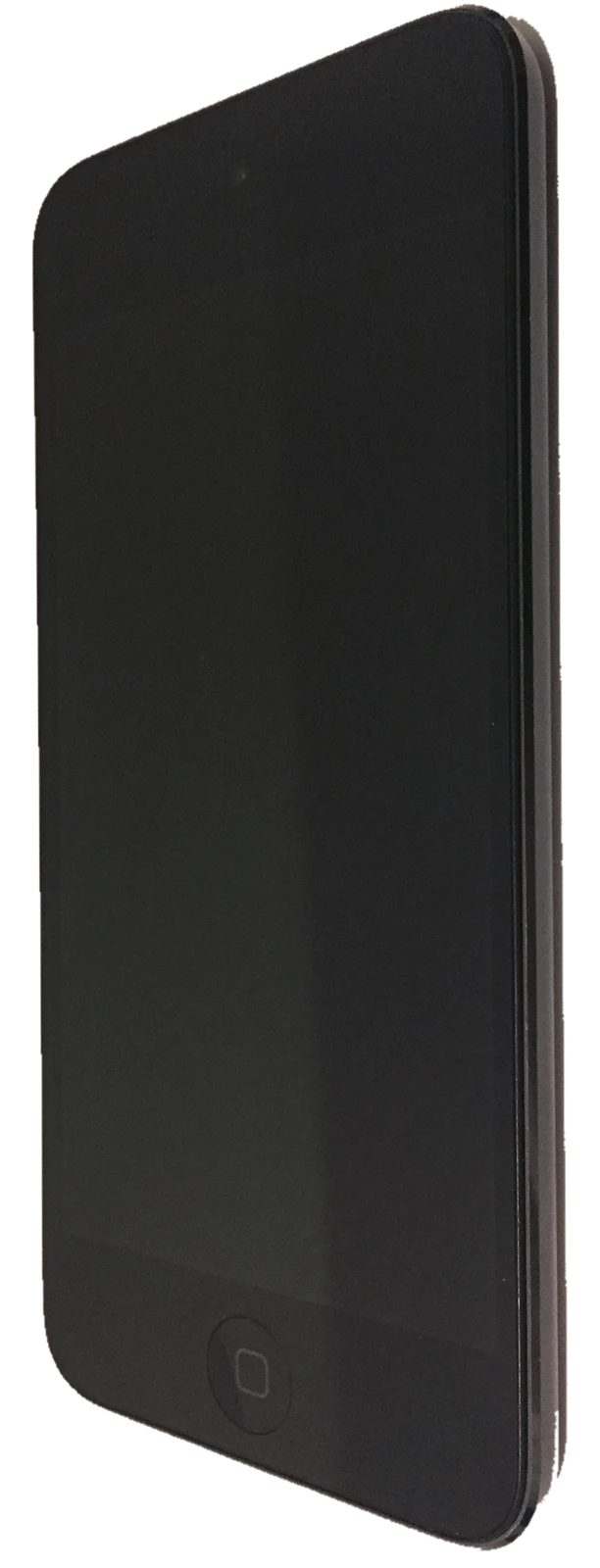
PocketJS runs on the sixth-generation iPod touch as a native UIKit application. The tested device is iPod7,1 on iOS 12.5.8 (16H88) with an A8 processor and a 640×1136 Retina display. The host exposes a 320×568 logical viewport at raster density 2.
Execution path
The application statically links engine/apple:
pocket-modowns the QuickJS guest realm.pocket-ui-surfaceinstalls the synchronousui.*operations and feeds the baked asset package.pocketjs-corelays out and software-rasterizes the draw list.PocketSurfaceViewadvances the guest from a 60 Hz main-run-loop timer, presents the framebuffer through Core Graphics, and maps UIKit touches back to logical coordinates. The iPod host selects this explicit clock because its jailbroken iOS 12 runtime does not deliverCADisplayLinkcallbacks; the default Apple host keeps the display-link path.
The iPod host publishes ipodtouch-dev / ABI 7. The NativeScript simulator shell continues to publish ios-dev / ABI 7. A plan-built guest refuses to mount when the target identifier differs, even though both hosts share the same operation ABI.
Build and deploy
The host requires Xcode, Rust's aarch64-apple-ios target, Bun dependencies, ldid, libimobiledevice, and a Checkra1n-jailbroken device. Checkra1n exposes Dropbear only through usbmux device port 44 in this workflow. The local tunnel defaults to 127.0.0.1:2223; it does not open a Wi-Fi listener.
rustup target add aarch64-apple-ios
bun install --frozen-lockfile
bun ipodtouch doctor
bun ipodtouch build
bun ipodtouch deploy
bun ipodtouch launch
build resolves apps/ipodtouch-demo/pocket.json, builds its Solid guest and pak, compiles pocket-apple for arm64 iOS 12, links a UIKit executable, and pseudo-signs it with ldid. Generated output is dist/ipodtouch/PocketJSiPod.app. The build ID hashes the compiled libpocket_apple.a in addition to the guest and host inputs, so any transitive native-code change produces a different device receipt.
deploy performs these checks before replacing the installed bundle:
- Re-identify the USB device as the exact tested model, system version, build, and activated state.
- Start a new
iproxytunnel bound to that UDID and verify the jailbreak's SSH host key with the dedicated key in~/.cache/pocket-stack/ipodtouch/keys. Deploy, launch, status, and capture never reuse an existing local tunnel. - Acquire a device-side deployment lock and extract through transaction-unique archive, unpack, stage, and backup paths.
- Verify the staged executable's pseudo-signature and compare every recorded file with its local SHA-256 hash.
- Rename the old bundle to its transaction backup, commit the stage, set ownership, verify the executable, and register the exact bundle with
uicache. The prior bundle is deleted only after every post-install check succeeds; any earlier failure restores and re-registers it.
The installed path is /Applications/PocketJSiPod.app. The command does not modify activation, firmware, root filesystem mounts, jailbreak packages, or other applications.
While the dedicated demo is active, the host disables the application idle timer. If iOS reports a near-zero display brightness when the app becomes active, the host restores it to 60 percent. The host re-enables normal idle behavior when it enters the background. The runtime receipt records both the observed brightness and idle-timer state.
App icon
hosts/ipodtouch/Icon.svg is the only authored icon source. It uses the Pocket homepage's #05070d, #070a11, and #101827 dark surfaces with restrained #60a5fa and #22d3ee iOS 7-style ambient highlights. There is no baked outer frame; SpringBoard applies the installed rounded mask. The centered light mark preserves the exact compact Pocket geometry from site/assets/favicon.svg. tools/ipodtouch-icon.ts rasterizes that SVG into the 57, 114, 120, and 180-pixel iOS PNG names and produces the opaque 4-inch launch images. For each output, the rasterizer asks the SVG renderer for an eight-times target-sized vector raster and reduces each 8 x 8 sample block with an exact area average. The small mark uses gradients without SVG filters, clipping, or fractional inner strokes, so curved internal edges are sampled once and remain antialiased at 57 pixels. No generated PNG is committed. The bundle receipt hashes every baked file that deployment reads back from the device.
Hardware acceptance
After launch, the app writes /private/var/tmp/pocketjs-ipodtouch.status.json. The receipt contains the build identity, PID, guest frame counter, screen geometry, completed touch sequences, the most recent application action, and any runtime error.
bun ipodtouch status
# Tap and release the blue Hero action on the iPod.
bun ipodtouch status --require-action
bun ipodtouch capture
The action-level check accepts only hero_tap with a positive value after a completed touch sequence. capture copies the device-rendered UIKit frame to dist/ipodtouch/device-frame.png for visual inspection. A successful build, bundle copy, icon registration, or launch request is not a rendered-frame and input receipt.
The 320 x 568 logical surface exceeds the legacy touch wire's 9-bit Y range. The Apple host emits the framework's wide 10-bit touch form for this surface, so the bottom action remains hittable instead of being clamped to Y=511. At the down edge, the Apple core resolves the committed-frame bounds hit once and carries that hit fact beside the contact as frame() argument 4 until release.
The jailbreak is semi-tethered: after a full reboot, run Checkra1n again before using deploy or launch. The installed app and dedicated SSH public key remain on the data volume, but the USB Dropbear endpoint is unavailable until the jailbreak is active again.