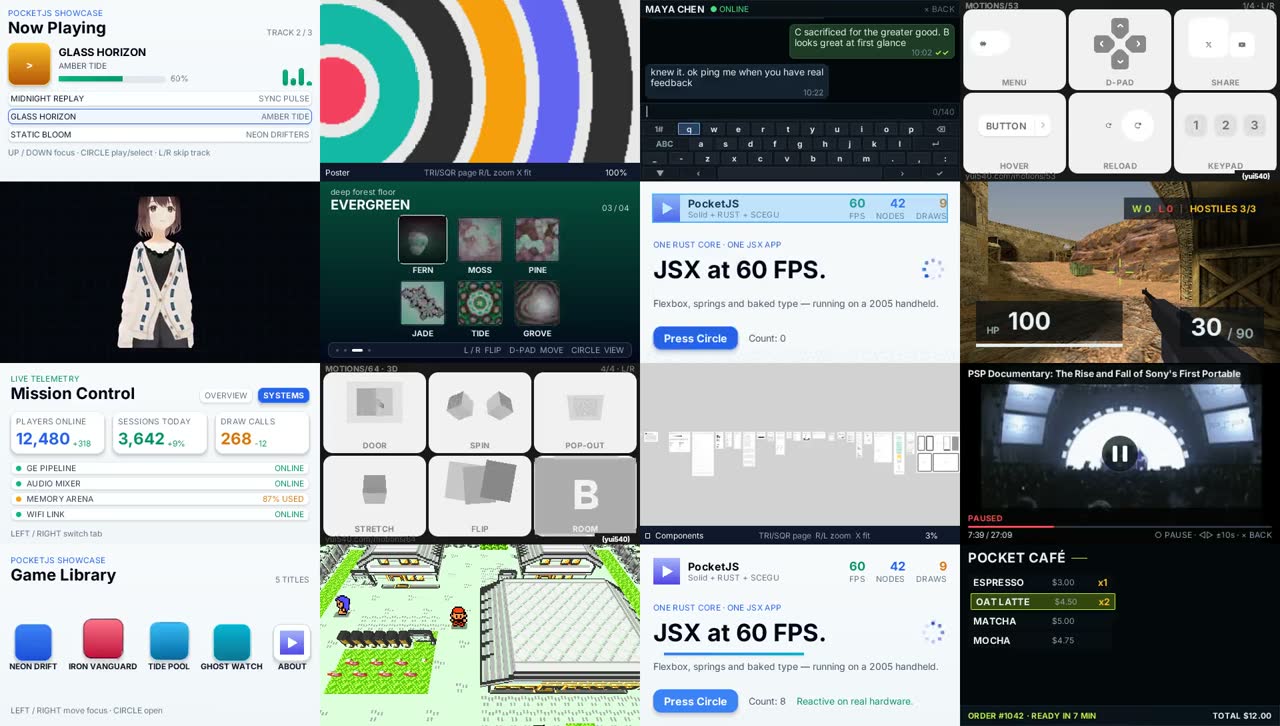
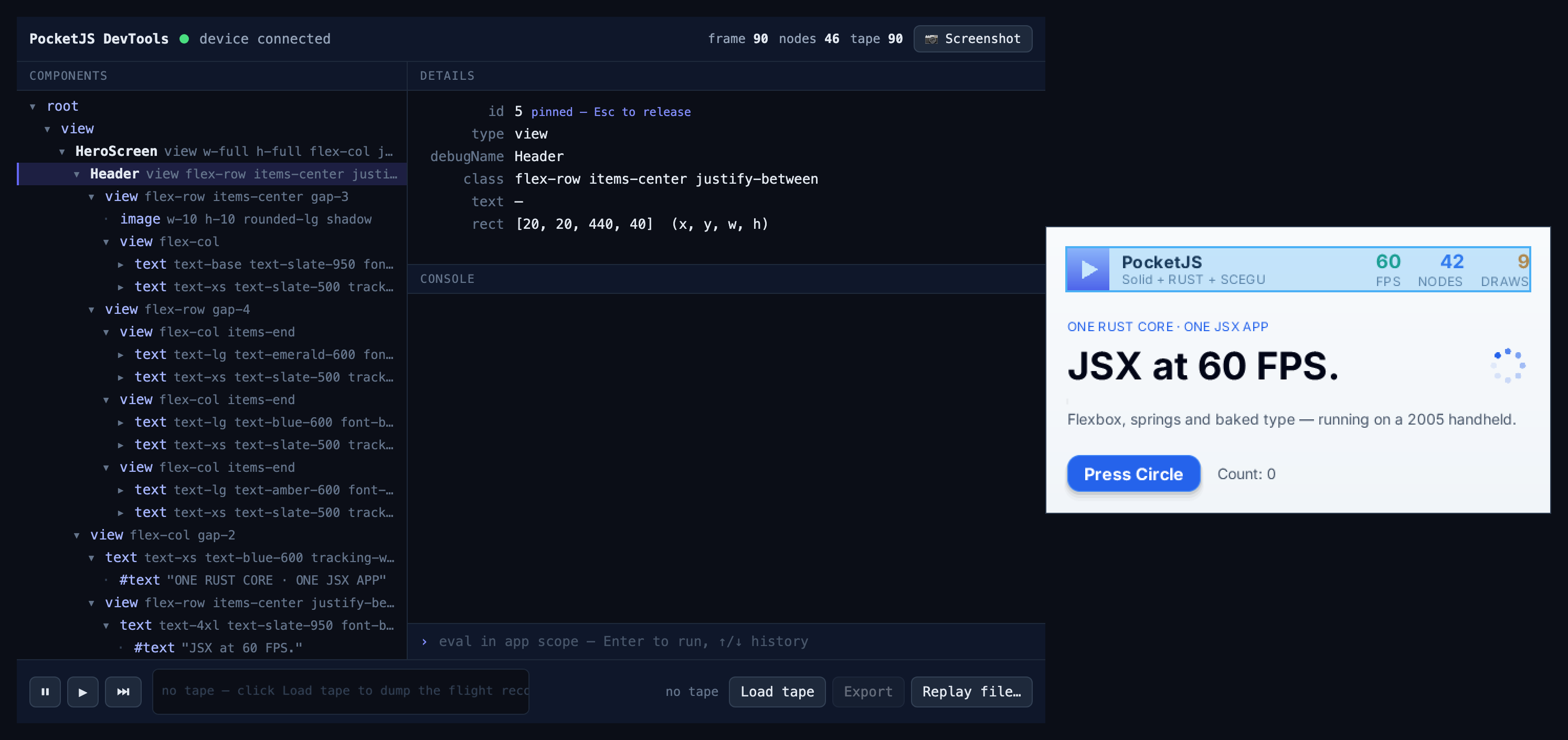
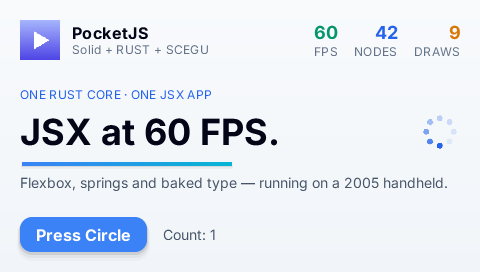
PocketJS's frame contract makes every app a pure fold over its inputs:
state[n+1] = F(state[n], input[n])
pixels[n]  = G(state[n])
One frame(buttons) call is one transaction: clock advance, effect deliveries, app hooks, input edge-detection, Solid effects, sweep, then 60/hz core ticks. Nothing else can touch the world — no wall clock, no microtask races, no mid-frame callbacks. Same tape in, same trajectory out, byte for byte. This document covers the three pieces that make the fold airtight and testable: the virtual clock, the effect shell, and the deterministic sim host. tests/sim.test.ts proves each claim in CI; tools/flake-lab.ts is the control experiment showing what happens to the same app under a wall clock.
The virtual clock (@pocketjs/framework/clock)
Time is the frame counter. The simulation rate — virtual frames per second — is a host policy, not app code:
hardware refresh   PSP vblank / browser rAF / none (headless CI)   → pacing only
virtual rate (hz)  1..60, must divide 60                           → the world's clock
core ticks         60 per virtual second, exactly FIXED_DT each    → unchanged, byte-exact
A virtual frame at rate hz is one JS frame() transaction plus 60/hz core ticks. The core never changes: ms-based animations, transitions and baked timelines cover the same virtual time at every rate — a 300 ms tween is 300 ms at 60 Hz and 300 ms at 2 Hz, just sampled coarser.
The 60 above is the spec default tick rate, not a constant of the model: a realm may declare another whole rate (1..240) before its first tick (Ui::set_tick_rate; tools/build.ts --hz bakes the same rate into the bundle), and the step stays fixed at 1/hz s for the whole run — the frame counter remains the only clock. The declared rate is part of the mount contract: the host publishes it as ui.__tickHz and a bundle refuses a host driving any rate but the one it was built with. Everything this document derives holds per realm with 60 read as that realm's rate; the committed goldens and tapes all run the default.
Hosts publish the policy as globalThis.__simHz before the bundle evals (web host: ?hz=2; sim host: scenario option; PSP: standalone packages at 60, multi-app packages at 20). Apps read time through the clock API and stay hz-portable by expressing time in seconds, never raw frame counts:
import { after, virtualNow, simulationHz } from "@pocketjs/framework/clock";

after(1.5, () => setPhase("menu")); // fires 1.5 VIRTUAL seconds out —
// frame 90 at 60 Hz, frame 3 at 2 Hz, the same instant of the same journey.
after() is the deterministic replacement for setTimeout: its deadline is a frame index, its firing order is (deadline, insertion order), and it holds no reference to the wall clock at all.
The subsampling theorem (proved per-frame in tests/sim.test.ts): for an app whose JS state changes only on events and virtual time (no per-frame counters), the hz-world is not an approximation of the 60 Hz world — it is the 60 Hz trajectory, strictly subsampled:
pixels_hz[m] == pixels_60[(60/hz)(m+1) - 1] for every frame mA 6.5-second journey is 390 observations at 60 Hz and 13 at 2 Hz — same trajectory, same final screen, byte-equal. That is what makes the low-rate world the natural habitat for agents and CI: ~30× less to record, replay, and look at, with nothing semantic lost.
Frame-counted APIs (onFrame counters, sprite frameStep) are per-rate by definition — an app that hard-codes "on frame 37" means something different at each hz. That is a documented boundary, not a bug; write seconds.
The effect shell (@pocketjs/framework/effects)
Buttons were already part of input[n]. The effect shell makes everything else part of it too. An app never awaits a promise and never registers a native callback:
import { runEffect, installEffectDriver } from "@pocketjs/framework/effects";

runEffect<Receipt>("order", { items }, (receipt) => setReceipt(receipt));
A command goes out; the result comes back as a frame-boundary delivery — queued whenever the driver produces it, applied at the start of the next virtual frame, before app hooks, FIFO. Deliveries are data in the frame transaction, not scheduler weather. The API is callback-based on purpose: promise resolution is timed by the microtask queue, which is a hidden input owned by the JS scheduler — exactly what the shell exists to exclude.
Drivers do the real work, and are swappable per host:
- an app-installed driver (
installEffectDriver) — e.g. the café demo's fake backend, which answers in virtual seconds viaafter(), making the whole app a closed deterministic system on every host including the PSP; - a host-injected driver (
globalThis.__pocketEffectDriver, wins) — how a harness takes over any bundle: replay a recorded effect tape, or deliberately deliver on wall-clock timers (tools/flake-lab.ts).
A run's effect activity is observable through globalThis.__pocketEffectTrace — every command and delivery with its frame index. That trace plus the input tape is the complete causal record of a session.
The sim host (hosts/sim/sim.ts)
A PocketJS host with no screen, no vblank, and no wall clock — it drives virtual frames as fast as the CPU allows and records everything:
import { runScenario } from "./hosts/sim/sim.ts";

const trace = await runScenario({
  app: "cafe-main",
  hz: 2,                    // the 2 FPS agent world
  seconds: 6.5,             // 13 virtual frames
  script: [                 // input in virtual SECONDS — one journey, every rate
    { at: 1.0, press: BTN.CIRCLE },
    { at: 3.5, press: BTN.START },
  ],
});
trace.hashes;    // FNV-1a of the framebuffer after every frame
trace.effects;   // every command/delivery with its frame index
trace.tree;      // DevTools component tree after the final frame
trace.finalFrame // raw RGBA, for byte comparison across rates
Assertions are equality on traces. A "flake" is impossible by construction, and tests/sim.test.ts demonstrates it the hard way: chaos mode injects real wall-clock sleeps, allocation churn and forced GC between frames — the trace must not change by one bit (and doesn't).
The 60 Hz café journey (390 frames, full per-frame pixel hashing) replays in well under a second — a 6.5-second user session, verified pixel-perfect, faster than one frame of the real thing takes to show.
The control experiment (tools/flake-lab.ts)
One bundle, one journey, two clocks:
- Runtime W paces the same 60 Hz world with real
setTimeout(rAF-style accumulator, timer jitter, occasional injected stalls) and delivers the order result on real wall-clock timers with network-like jitter. This is a normal day for a browser test — nothing exotic. - Runtime V is the sim host.
Both measure the frame at which the order confirmation enters the world, and a Playwright-style assertion ("confirmation visible by t=2.5 s"). W produces a distribution of delivery frames and a partial assertion pass rate; V produces one frame index, every run, forever. Same code. The only difference is what "time" means.
What this does NOT claim
- A 2 Hz run validates the 2 Hz world's semantics; it does not re-verify every per-frame detail of the 60 Hz world (the subsampling theorem covers shared points, not the frames in between — those are covered by running at 60 Hz, which is just as deterministic).
- Determinism ends where an unrecorded input enters. A LIVE network driver is nondeterministic by nature — record its deliveries (frame + payload) and replay the tape; the replay is then exact. The shell is what makes that recording complete.
Math.random(),Date.now()and friends are not fenced off by the runtime. The contract is: express randomness as seeded state and time as the virtual clock. The café demo needs neither.